The Mockingbird’s Song
.Creative Intelligence in the Wild
Lillian Skinner
6/11/202612 min read
I. A Bird Without Its Own Song
I grew up with a mother who was a serious birder. She took my siblings and me on miles-long hikes every day she could. On every one of them she carried a bag with three field guides. No snacks or water, just books on birds, plants and mushrooms with very dog-eared corners. I may not have cared much about any of those topics but I learned them anyway.
It is because of this that when a mockingbird started singing outside of my office window after a recent move I knew he was one bird passing as many. He was a prolific singer. He would start a day off with a hawk’s piercing cry, slide into the liquid phrase of a wood thrush, pivot to the two-note chirp of a city crosswalk signal, move to something that sounded like a spring peeper, and fold it all back into a long chorus of songbird songs from the area. The transitions were seamless, and the key changes were made like a pro.
When I was younger, I thought mockingbirds had no song of their own. But as an adult I realized they did. It was their unique connection of songs and sounds that was their creation. The mockingbird does not imitate. It composes. It creates a reality soundscape of its territory, in real time, to let everyone in earshot of whatever is happening right now.
They are different than the other birds because of this. Different than the birds of prey and songbirds. It is a different order of intelligence. A higher order that can hold the whole environment as its subject matter and produces from it a live model of the world, continuously updated and broadcast. To understand what makes this exceptional, we have to see the full spectrum of bird intelligence that surrounds it.
II. A Bird Intelligence Spectrum
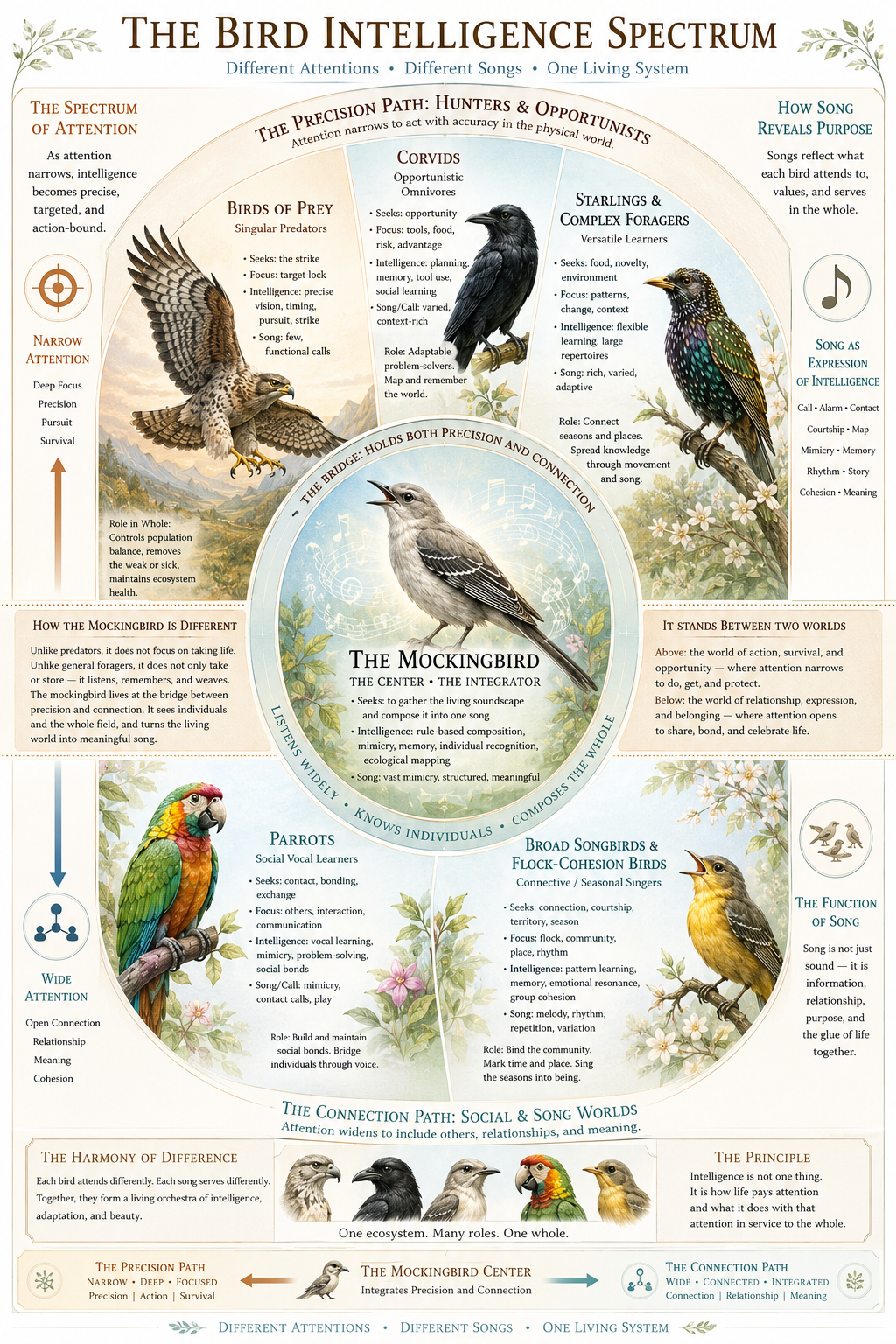
Intelligence in nearly every animal is not a single thing. Across species it has taken we recognize different forms. How much of that form they have is shaped by what each bird needs and what they primarily focus on. One group has the narrow focus of a hunter. Another group has a wider focus of connection.
The mockingbird stands alone in their balance of both results in a qualitatively different position. It holds its attention wide open to produce something the others do not generate with the same degree of clarity.
The Precision Path: Hunters and Opportunists
The birds of prey share one defining quality: forward-facing eyes. Showing attention toward a specific target and intelligence that organizes entirely around precise accuracy. Their songs are few and functional. What they need to communicate pierces the calm of the sky.
Birds of prey — hawks, falcons, eagles, owls — represent this path in its purest form. A peregrine falcon in a dive reaches 240 miles per hour, its entire nervous system committed to one target, one act, one outcome. It locks onto a single signal and eliminates everything else from its processing until the task is complete. Precision, timing, pursuit, strike. Their intelligence depth and breadth are exactly what they need to survive.
Corvids — crows, ravens, jays — bring the precision path to a wider sophisticated expression. They are opportunists rather than singularly focused. They plan, remember, and learn from others. It is the crow who drops a walnut on a crosswalk and waits for a car to crack it. They have learned a tool-use strategy built on memory, timing, and causal understanding. Ravens remember individual human faces for years. Corvids map the world knowing where things are, who did what, what is likely to happen next. Their calls are more varied than the birds of prey, context-rich, and carry the information about what they have found and what they intend.
Starlings and complex foragers extend their focus breadth to include social learning. A starling murmuration has thousands of birds moving as one fluid body. During which they distribute information processing precisely. Each bird tracks its nearest neighbors, and together the whole flock responds to threats faster than any single bird could. Starlings seek novelty, learn from watching others, and spread ecological knowledge through movement and song. Their intelligence is flexible and pattern driven. As they fly they scan and plan what will be the next move..
The focus of a predator — from the falcon’s target lock to the corvid’s causal planning to the starling’s adaptive pattern tracking — all share one direction: attention narrows to act with accuracy in the world.
The Connection Path: Social and Song Worlds
The birds whose focus is connection, move in a very different manner. Their eyes sit further apart, and their attention widens to include others. They are relationship focused. They carry living bonds that hold communities together. Their intelligence is empathic connection based. They connect across states to learn about the other beings and ecosystem they share. Their sensing drives them with a wider breadth that that demonstrates its power.
Broad songbirds and flock-cohesion birds — finches, warblers, thrushes, and sparrows sing as a community for the rest of the world. A hermit thrush’s spiraling phrases follow the harmonic series so closely that musicologists study it as a model of natural tonality. A winter wren produces songs so dense they sound more like rushing water than a single animal. These birds pleasant sounds demonstrate something cognitively remarkable. They show how a reading of the shared seasonal state of their community. That they then reflect as song. They mark time and place, bind the flock together across distance, signal health and threat through subtle variations in rhythm and tone. Their song is the social fabric of the ecosystem made audible. A song where every member of the community hears and is updated on the state of their whole.
Parrots bring the connection path slightly narrower so much so that it crosses species. They are social vocal learners whose intelligence is built entirely around connection. When a parrot learns a human word, it converges acoustically with the individual it lives with. It matches their sounds as an act of bonding, signaling belonging through voice. Parrots know the state of their flock. They show extraordinary sensitivity in their adaptation to behavior in real time. Their intelligence is relational using contact, resonance, and exchange. They recognize individuals, and they use a specific voice to maintain the living bonds to create community.
The Mockingbird: The Bridge That Holds Both
The mockingbird sits at the center of this spectrum, as the center. Representing a genuinely different position. It holds both the connection and focused perception to produce an integration the others do not generate.
The mockingbird attends with the precision of the hunters and the connection orientation of songbirds as one. It listens across the entire field. Notes the predators’ calls, corvid chatter, insect sounds, frog croaks, wind, water, human alarms holding them all in memory, context, and order. Roeske, Rothenberg, and Gammon (2021) documented that it does not string these sounds together randomly. Instead, it morphs between them using principles of musical composition: shifting pitch, timbre, and timing in ways that follow harmonic logic. Each transition lands coherently in relation to what preceded it.
The mockingbirds demonstrate a higher-dimensional use through how many layers they use of reality. The ability to keep many active relationships at once while composing. The red-tailed hawk’s cry carries information about the upper canopy, open sky, and the predator gradient above. The wood thrush’s phrase carries information about the understory, moisture levels, and the health of the mid-territory. The car alarm carries information about proximity to human activity and the specific threat profile that comes with it. The spring peeper carries information about temperature crossing a specific threshold and the season turning. Each of the 200-plus sounds in the mockingbird’s repertoire is a live data stream from a different dimension of their territory’s reality. The mockingbird holds all of them to produce its song. Compressing all those dimensions into a single coherent broadcast.
That is what higher-dimensional awareness means in practice: more simultaneous layers of reality held in active relationship and synthesized into something the whole living system can use. It is precision and connection working together. From the hawk’s dimension to the thrush’s dimension to the frog’s dimension to the human’s dimension composing all into a single song. To tell the whole territory what is happening or could be happening right now.
III. A Mockingbird Broadcasts: Interspecies Knowing
The mockingbird’s song is a service. A continuous, multi-channel information broadcast that runs for every creature in earshot. One that no other bird on the spectrum provides, because no other bird holds all the dimensions simultaneously.
Weather report: The composition reflects the current state of the acoustic landscape in real time. Detailing which species are active, what the energy of the territory is doing, how the atmosphere is sitting, and what has changed since yesterday. Any animal nearby receives a read on the ecology of the whole landscape without having to survey it themselves.
News broadcast: When a chickadee sounds a predator alarm, the mockingbird registers it and propagates the information across species lines in its own voice. When a new species enters the territory, its call enters the composition. The mockingbird broadcasts what is happening to the whole community, functioning as an across species translator, emergency broadcaster, and news anchor simultaneously.
Public safety announcement: Levey and colleagues (2009) documented that urban mockingbirds learn to identify specific people. They assign each a threat level based on direct experience and updating that assessment continuously. This individualized, real-time risk mapping is broadcast as acoustic behavior for every animal in range.
Ecological census: The texture of the mockingbird’s song at any given moment encodes the species composition of the territory. It might detail which birds are present, which are absent, what population levels suggest about the health and balance of the ecosystem. The bird performs a continuous biological survey and broadcasts it as the ongoing fabric of its composition.
This is interspecies knowing. The songbirds connect deeply within their own kind, demonstrating 3D connection capabilities. The mockingbird takes that connection across species lines. Holding the whole living system in mind to give it back as something every creature in the territory can orient by. That cross-species synthesis shows the 2D precision reading the hawks, the 3D connection reading of the thrushes being held and composed into a unified broadcast as a 4D function. And they are the only one bird in a territory doing it.
The songbirds connect within their kind. The mockingbird connects the whole. It is contributing by holding the ecosystem together as whole and giving it back as song.
IV. Three Human Types: The Same Spectrum
The bird’s intelligence spectrum mirrors the human intelligence spectrum. It describes how intelligence distributes itself across any living community. In human communities the same three positions appear. Two common paths and one less common integrating center between them.
The precision path in humans is the cognitive mind: the analyst, who dissects systems into labeled parts and acts on what can be isolated and measured. This intelligence drives toward dissection, definition and control. At its most focused it resembles the falcon. Focused on a clearly defined target. Its dissection divides connection into parts. The result is a proliferation of roles and institutions that civilizations are born from. But what dissection cannot do alone is heal connection, detect deeper issues or create solutions.
The connection function in humans is strongest when it comes from the body. This intelligence perceives state of living systems profoundly. Its channel is a hundred million times the head. Using connection that grounds into reality the knowledge needed to understand the focus of the mind. The empathic mind reflects what is happening. It learns immersively and at its fullest expression it resembles the songbirds. Demonstrating extraordinary breadth of connection to the living community, binding people together through knowing the details of the individuals and their needs that surround them.
Creative intelligence is the mockingbird position. It carries the intelligence and awareness of the whole. It uses both positive and negative space patterns and structures across domains. Discerning what needs to be the focus for the whole. Its integration means it sees the whole and produces what is needed to create balance so that everyone shares the same working model of their territory at that moment, providing something entire community can navigate by.
V. The 4D Function: Gap-Reading, Mental Modeling, and Creative Foresight
What creative intelligence produces from holding the whole is a qualitatively different cognitive operation. It is the ability to read the gaps between the other intelligences and know from those gaps the needs of the whole system and where it is heading.
Using cognitive dissection and empathic connection. It produces a present knowledge of the living states. Creative intelligence lives in that gap to see what the precision thinkers are missing and what the empathic thinkers are missing to produce something neither intelligence could produce alone: a model of reality’s whole.
This internal working representation of how a system functions, built from perception across dimensions, comes from an internalized understanding of the acoustic principles that make transitions between all those calls coherent. Which is why it generates combinations that have never existed before and yet it still makes sense. It holds the structure beneath the surface, and it uses that structure to compose in real time.
Creative intelligence in humans works similarly. The creative operates at the level of intelligence known as intelligere. The Latin faculty of whole-seeing discernment, from inter (between) and legere (to read). This intelligence works from a model of how the individual’s reality naturally functions. Because that model includes the dynamics of the system, in its past and present state to know where it is heading before reality presents itself. When the dynamics shift, the model registers it before the metrics can follow.
This creative foresight is driven specifically by cerebellar cognitive flexibility. The capacity to hold multiple dimensions in active relationship simultaneously and read their patterns to know where they are going. It is the only intelligence that can comprehend living systems in motion. Because it integrates its present with past pattern recognition. The mockingbird registers a new call entering the territory and immediately knows what dimension of the landscape has changed and what that means for the whole. The creative human registers a pattern moving through disconnected domains and knows what is coming before any single domain has named it.
Beaty and colleagues (2025) found that creative ability in humans is predicted by the dynamic switching between the brain’s spontaneous associative network and its focused executive network. Which does not correlate with IQ, because IQ is measured only for dissection. The connection of the body and the dissection of the mind are different cognitive configurations specialized for different functions. Only the creative mind can integrate them deeply enough to create the function the mockingbird performs. The function of holding all the dimensions at once to comprehend and compose how their relationships impact the whole.
VI. When the Mockingbird Goes Silent
Every type of intelligence is needed to keep healthy systems. The hawks and falcons maintain the balance of prey populations. The corvids map and remember the landscape. The starlings track change and spread it through collective behavior. The songbirds bind the community together through felt seasonal rhythm. The parrots maintain the intimate bonds that make group life possible. Each intelligence serves the whole by doing what it does best.
What the mockingbird adds is a central reporter who holds the whole together. The ecosystem is healthier and more adaptive when this intelligence is present understood and cultivated. When conditions change, the mockingbird’s song registers the change and broadcasts it before any other signal in the territory has named it. If that function is removed, even when all the other birds still perform their role, the territory loses its early warning system. It loses its cross-species translator, and the voice that keeps the whole system honest about reality
Human communities built on Cartesian dualism, the philosophical split that declared our present-focused, dissection-based cognitive intelligence the only legitimate form of awareness, and devalued the past-focused, connection-based body intelligence as subjective erased. It erased the people who carry the intelligence that was future-focused, higher-dimensional and that sees what is coming. The education systems that require children to sit still and ignore the body’s needs are atrophying the embodied connection between the head and body intelligence. The bridge that makes the mockingbird’s functioning possible.
But creative intelligence can still be found in some. In those whose sensitivity keeps the mind and body repairing itself. Those who can see the gaps between the domains that the specialists separate. Those who warn what will happen before the 2D metrics record it. Those who create in a pinch exactly what is needed to adapt. Because that is what this intelligence was built to do. Recognizing is crucial and preserving it in our children is key. The system professionals do not have mockingbird intelligence. Because if they were they would recognize it is not a deficit, a disorder, or an inability of any kind. The mockingbird function is the rarest and most necessary intelligence in every sustainable living system. The one that holds the whole territory in mind and keeps it navigable for everyone else.
References
Audet, J.-N., Couture, M., & Jarvis, E. D. (2023). Songbird species that display more-complex vocal learning are better problem-solvers and have larger brains. Science, 381(6664), 1170–1175. https://doi.org/10.1126/science.adh3428
Beaty, R. E., Benedek, M., Kaufman, S. B., & Silvia, P. J. (2015). Default and executive network coupling supports creative idea production. Scientific Reports, 5, 10964. https://doi.org/10.1038/srep10964
Chen, Q., Beaty, R. E., et al. (2025). Dynamic switching between brain networks predicts creative ability. Communications Biology, 8, 54. https://doi.org/10.1038/s42003-025-07470-9
Levey, D. J., Londoño, G. A., Ungvari-Martin, J., Hiersoux, M. R., Jankowski, J. E., Poulsen, J. R., Stracey, C. M., & Robinson, S. K. (2009). Urban mockingbirds quickly learn to identify individual humans. Proceedings of the National Academy of Sciences, 106(22), 8959–8962. https://doi.org/10.1073/pnas.0811422106
Roeske, T. C., Rothenberg, D., & Gammon, D. E. (2021). Mockingbird morphing music: Structured transitions in a complex bird song. Frontiers in Psychology, 12, 630115. https://doi.org/10.3389/fpsyg.2021.630115
Sternberg, R. J. (1985). Beyond IQ: A triarchic theory of human intelligence. Cambridge University Press.
© 2025. All rights reserved.