Navigating Change Together
At the Creative Intelligence Institute, we study the skills and insights needed to thrive in a rapidly evolving world. Our goal is to understand each child where they are at and cultivate them in a manner that uses whole intelligence.
Learning naturally involves our whole intelligence. Students learn emotional mastery as we demonstrate how emotions facilitate learning. We use emotions that open students up to learning. We encourage children to use their curiosity, wonder, and interest to guide them in the learning process. This makes learning enjoyable and natural. We host an environment that encourages expansion rather than forcing contraction. The more creative a child is, the less the standard education system meets their intellectual needs or cultivates the depth and breadth of their intelligence.
When students enjoy learning their curiosity grows, their interest peaks they will naturally explore and seek to grow. They will connect the information they learn across domains. This results in connection that integrate their intelligence and expands awareness.


Youth Enrichment Classes
Ages 10-14
Learning Through Creation
We are facing the most significant economic transition since the printing press. AI will displace 92 million jobs while creating 170 million new ones. The pattern is familiar, but the specifics are unprecedented: routine cognitive tasks—data entry, basic analysis, documentation, calculation—are being automated. The skills current education optimizes for are precisely what AI does best.
Most education systems still reward memorization, individual performance, and technical accuracy. 44% of workers’ core skills are expected to change by 2028. Many jobs today’s students will hold don’t exist yet. The system built to prepare children for the industrial economy is now preparing them for obsolescence.
What Remains Valuable
In an era dominated by AI—capable of relentless analysis, documentation, and detail work—humanity’s unique strength lies in cognitive flexibility: the ability to adapt, recognize cross-contextual patterns, and innovate in response to change.
Yet, traditional education trains children to function like AI—prioritizing rote stamina over creativity. Research reveals a stark truth: while 98% of children enter school with creative genius, only 2% of adults retain it. Our systems fail to nurture what matters most in a world of ecological collapse and AI-driven labor: Whole Picture Intelligence and Creativity.
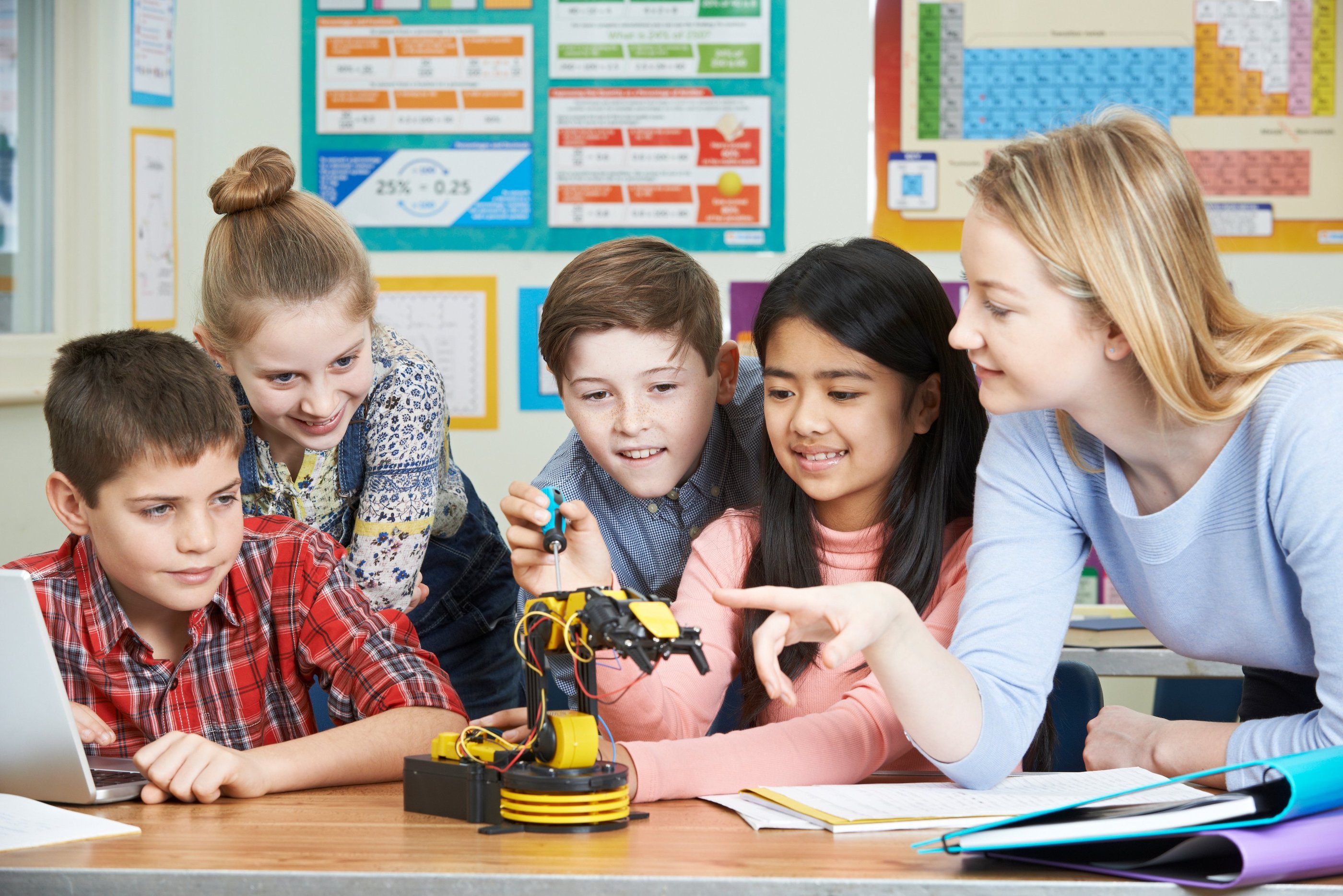
Our approach addresses that. We cultivate creativity by integrating theory, pattern recognition, and hands-on creation—exercising humanity’s whole, naturally adaptive intelligence. This educates and building the hands on skills needed to navigate the future they face.
Why Hands-On Learning Matters
Children think with their whole bodies. They understand fractions by cutting fabric, grasp physics by building circuits, and create with chemistry when cooking recipes. This is how human intelligence works. Our education system labeled it an "alternative learning style" to justify training it out of children, creating a worker class optimized for industrial tasks - skills that is now obsolete in an AI-driven world.
All children learn through movement and process through patterns. We label those who cannot disconnect body from mind as neurodivergent. But is that accurate? No, every baby is born learning primarily with their somatic (body) based intelligence. If they keep it they are labeled as learning differences: dyslexia, dyscalculia, ADHD. The system sees disorder because it measures only for an what AI does better: cognitive stamina.
Sensitivity preserves what the system conditions most to lose: integrated intelligence that processes through the body, recognizes patterns across domains, and adapts instead of fragmenting.
The World Economic Forum has identified neurodivergent thinkers as essential for the future workforce and a competitive advantage. Their pattern recognition, creative flexibility, and resistance to cognitive fragmentation are exactly what adaptation requires. CEO's already recognize the value of the neurodivergent minds. Yet, education and medical systems continue to destroy this very intelligence every day.
Our Approach
Whole learning feels expansive. Because it that uses your whole intelligence and moves across disciplinary boundaries. Mathematics appears in sewing because pattern-making is inherently mathematical. Chemistry appears in cooking because cooking is applied chemistry. History appears in diorama-building because understanding how people lived requires knowing what they wore, the tools they used, and the spaces they inhabited.
Our courses nurture the mind-body intelligence children are born with.
They learn by moving, creating, and connecting ideas—building skills through creation. This keeps their integrated intelligence alive, strengthening their ability to recognize patterns, adapt, and innovate for the future.
Why this works:
"Mind-body intelligence" reflects the neuroscience of integrated cognition.
"Nurture" implies growth and development, not just preservation.
"Strengthening their ability to recognize patterns, adapt, and innovate" ties directly to the creative and cognitive advantages of this integrated approach.
Students learn practical applications and how theory integrates linear and nonlinear learning to provide a holistic creative perspective.
Class Format and Benefits
Online classes
Small groups: 4–7 participants
Intensive sessions: 1-hour enrichment classes
Project-based: Classes are designed to help students build a portfolio
Practitioner-led: Taught by industry professionals
Develop the skills to enter our Incubator and Entrepreneurial tracks.
Advanced students who excel in their classes are offered the opportunity to design their own projects and take on leadership roles within the institute.
View Our Current Classes
Or fill out the form below.
Classes are created to meet your child's specific needs.
© 2025. All rights reserved.